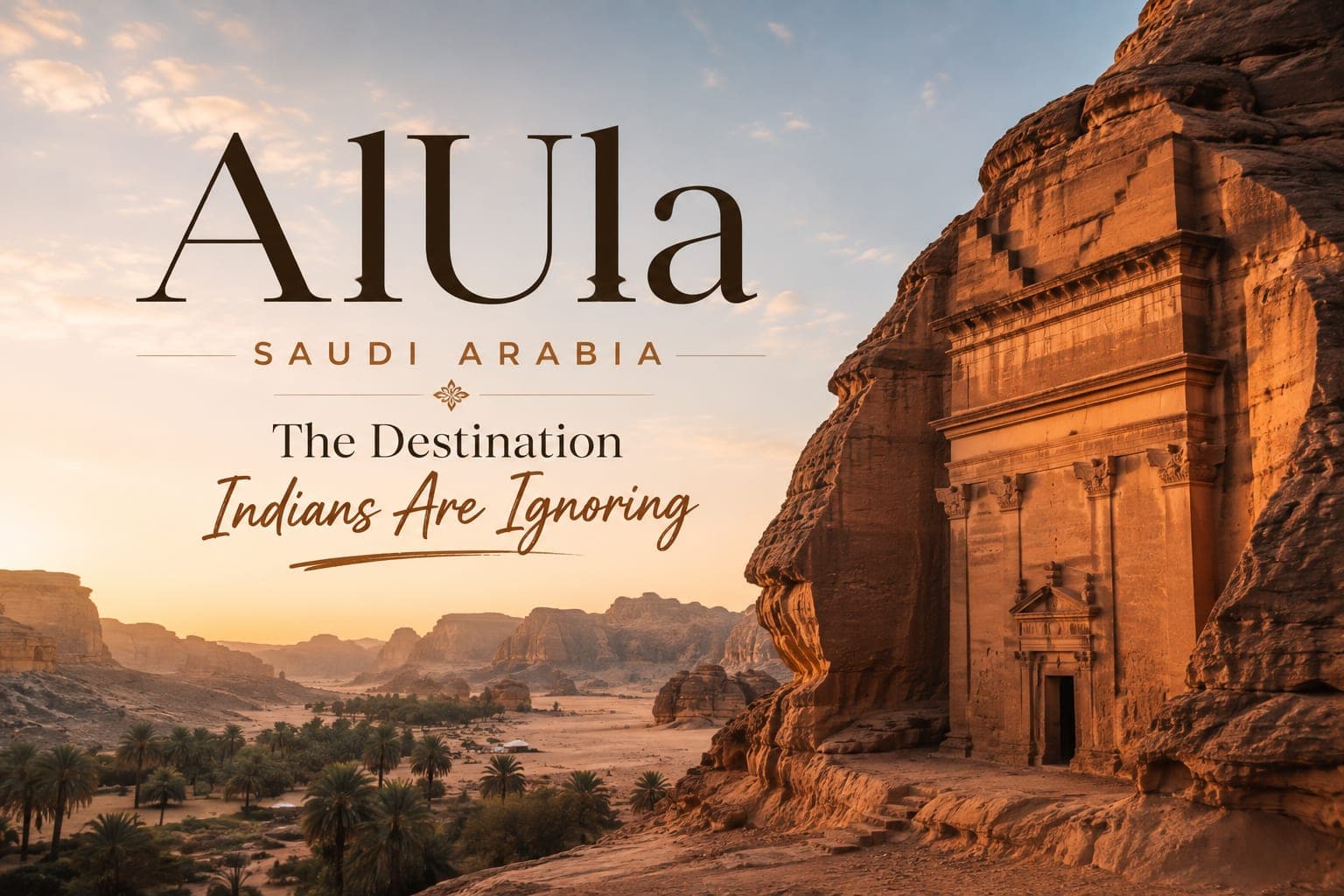
AlUla, Saudi Arabia: The Indian tourist destination yet to be discovered
Quick Answer: AlUla, a city in the northwest of Saudi Arabia, is home to a UNESCO-listed Hegra (the country’s first UNESCO World Heritage site), vast sandstone canyons and 200,000 years of human history. Saudi eVisa ($170) for Indian visitors. Direct flights from 7+ Indian cities to Riyadh or Jeddah with a connecting connection to AlUla is available.
Every few years something fresh opens and the masses come in. Tbilisi, 2015. Oman, 2018. Georgia’s wine country, a little later. And that place now is AlUla. And hardly any of the Indian travel bloggers has noticed.
Odd thing to forget. Since the government opened doors to international leisure travelers in 2019, the tourism infrastructure in Saudi Arabia has been developing at a fantastic rate. Saudi: Tourism statistics shows 22.7% YoY growth in hospitality facilities in Q1 2026. But that tourism drive’s jewel in the crown, AlUla, is rarely on the Indian travel map. Search for “AlUla India travel guide” and you get bits and pieces: a Reddit conversation here, a generic itinerary there. No telling.
This article is meant to do just that. It tells an Indian visitor what he/she needs to know about AlUla - what is it, why does it matter, how to get there, what to do and when to go. If you’re looking for a place with a rich history, magnificent desert landscape and authentic cultural immersion, but don’t want to deal with the crowds of Petra or the price tag of the Maldives, then keep reading.
Why You Should Be Looking at Saudi Tourism Now
Saudi Arabia’s drive into overseas tourism is relatively young, but gaining pace swiftly. There were virtually no leisure tourist visas for most nationalities before September 2019. The country was only open to business tourists, religious pilgrims to Mecca and Medina or those with family links.
That was until the Saudi government’s bold economic diversification plan, Vision 2030, came along. That strategy has tourism at its center and has seen billions of dollars spent on infrastructure, hospitality and heritage preservation around the country.
Results are in. Saudi Arabia’s hotel market saw blistering growth in Q1 2026, up 22.7% year-on-year, whether you look at it. New hotels, boutique resorts and bespoke experiences are springing up all the time, with AlUla in particular taking a disproportionate amount of the country’s tourism investment.
The Indian travelers are highly particular about time. “Saudi Arabia is at a stage where the infrastructure is there, the experiences are polished but the volume of visitors is not yet there. That’s where you get the best memories.
So what is AlUla? Destination in a nutshell
AlUla is a governorate in the Medina region of northern Saudi Arabia nestled in a natural desert valley surrounded by spectacular sandstone cliffs, ancient rock formations and 15,000-year-old petroglyphs. The valley is over 300 km long and has been continuously inhabited for at least 200 000 years.
“AlUla is layered with civilizations and that’s what makes it unique. Here developed the kingdom of the Dadanites. The Nabataeans — who built Petra in Jordan – erected a second city here at Hegra. Islamic & Pre-Islamic Heritage, Antiquity. The show includes about a fifth of the landscape itself, carved into great rust red formations.
The official tourism website for AlUla, experiencealula.com, advertises the destination as “History & heritage, arts & culture, nature, adventure & wellness”. Think of it not as one attraction but as an open-air museum the size of Belgium — except a lot warmer and far more gorgeous.
Hegra: Saudi Arabia’s 1st UNESCO world heritage site
Saudi Arabia’s first UNESCO World Heritage Site in 2008, Hegra, known in antiquity as Mada’in Salih, is without question the star of any AlUla itinerary.
Hegra was created about 2,000 years ago by the Nabataean civilization, a commercial society famous for its water engineering and rock-carved structures. Hegra was the southern capital of the Nabataean monarchy. The site consists of about 100 enormous tombs, carved directly into the sandstone outcroppings, and remarkably well preserved. Their faces are decorated with exquisite sculpting that has survived two millennia of desert winds.
Visitors often liken Hegra to Petra and the architectural connections are clear — both are Nabataean, both include tombs carved into rose-red rock. But Hegra possesses what Petra lost many years ago, tranquility. Petra is a place where you are rubbing shoulders with thousands of people each day. At Hegra, you might wander between the tomb faces with only a handful of other people. To be alone in total solitude in front of a two thousand year old carved tomb is an experience that is becoming rare anywhere on earth.
Access to Hegra is only available on a guided tour booked at experiencealula.com. Usually tours take 2-3 hours.
Dadan And Jabal Ikmah Rock Inscriptions Of Two Ancient Kingdoms
Prior to the Nabataeans, AlUla was the capital of the Dadanite and Lihyanite kingdoms and governed the north-western Arabian Peninsula from roughly the 9th century to the 2nd century BCE. Dadan, the ancient capital of those civilizations, sits just outside the modern town of AlUla.
Dadan is still a fairly active dig site therefore to visit now is one of those rare situations when you are discovering a place live. Stone lions, Dadan Culture Totems, Excavated Ruins.
Nearby lies Jabal Ikmah, an open-air library, a rare one in the region. On the rock wall of a narrow canyon, hundreds of inscriptions in the ancient characters of Dadanitic, Lihyanite, Aramaic and Minaic, left by merchants, travelers and priests over hundreds of years. Some inscriptions are almost 2,500 years old. A trek across Jabal Ikmah will get most travelers as close as they can get to comprehending the graffiti of an ancient society.
Heritage tours from AlUla Welcome Centre include Dadan and Jabal Ikmah.
AlUla Old Town: A Time-Trapped Mudbrick City
AlUla Old Town is a mediaeval town, composed of mud brick, stone and palmwood. It’s a maze. At its peak, the Old Town had about 900 houses in 400 tightly packed buildings connected by narrow covered walkways intended to fend off the heat of the desert.
The village was inhabited until the 1980s as its people gradually moved to the modern day metropolis of AlUla. It had been abandoned recently enough to leave the architecture still surprisingly intact. As you wander through the Old Town you come across mosques, watchtowers, souks and houses, some of which still contain the everyday possessions left behind by their last occupants.
The Old Town is the heart of the AlJadidah Arts District where heritage buildings have been converted into art galleries, craft studios and cafes. Here the present cultural life of AlUla meets its ancient layers. Experiencealula.com offers a guided twilight tour between Old Town and the nearby Oasis, about 75 minutes.
Adventure & Experiences in AlUla The heritage sites of AlUla alone are worth a visit but the area has so much more to offer.
Stargazing: AlUla is in the desert, away from large light pollution and is one of the greatest places to do stargazing in the Middle East. Several valley operators offer evening astronomy tours.
Rock-climbing and hiking: The sandstone cliffs around the valley have attracted climbers since the area was opened to tourists. Routes range from beginner friendly scrambles to challenging multi-pitch climbs. Take a walk around the Sharaan Nature Reserve which boasts spectacular canyon views.
4x4 Desert Driving: Guided 4x4 trips will take you through the sand dunes and rocky terrain of AlUla where you will see sights that are inaccessible on foot.
Heritage workshop: AlJadidah Arts District offers programs that include workshops on craft in traditional calligraphy, pottery and weaving. These are not demo-tours, but lessons from local artists, using techniques passed down for generations.
Maraya Concert Hall: Good to know especially considering how architecturally weird it is. Maraya is a music and events venue, mirrored in the middle of the desert. It is the world's largest mirrored building and this earned it a Guinness World Record. From afar it really looks like it disappears in the countryside. Inside it holds concerts, galas and cultural events all season long.
All About Saudi Tourist Visa For Indian Travelers
Indian citizens can apply for a Saudi tourist visa online, on the official Saudi eVisa portal (visa.visitsaudi.com). “It’s all done digitally, so there’s no need to go to an embassy.
Key details till 2025:
Visa type: eVisa for single or multiple entries
Validity: 1 year, multiple entry.
Lodging: No 90-day per-visit and 180-day per-year maximum
Cost: ~USD 160 (~₹13000) including travel insurance and tourism charges
Processing Time: Normally 24-72 hours
Required documents: Valid passport (must be valid for at least 6 months) Passport size photo Booking for return flight
Women travelling freely are no longer necessary under current Saudi regulations to have a male guardian (mahram) - a substantial policy change from just a few years ago.
Note: Mecca and Medina are off limits to all non-Muslim visitors. AlUla and all tourism destinations in Saudi Arabia are available to people of all faiths and nationalities.
How to reach AlUla from India
There are no direct flights from Indian cities to AlUla’s own airport (IATA: ULH) but the connection is simple.
Step 1: Book a flight from India to either Riyadh (King Khalid International Airport) or Jeddah (King Abdulaziz International Airport). There are direct flights from at least 7 Indian cities including Delhi, Mumbai, Hyderabad, Chennai, Bengaluru, Kochi and Kolkata. Airlines flying on these routes are Air India, IndiGo, SpiceJet, Saudi Arabian Airlines, Air Arabia and flydubai (via Dubai).
Step 2: Fly from Riyadh or Jeddah to AlUla. This service is provided by Saudia and flynas . Flight time from Riyadh to AlUla is roughly 1.5 hours; from Jeddah about 1 hour.
Most Indian metros would be 7-12 hours away from AlUla depending on layover duration. That’s roughly the same duration as a flight to Eastern Europe, and significantly shorter than a flight to South America or Southern Africa.
When to visit AlUla AlUla’s major tourist season stretches from October to March, with daily temperatures of between 15°C and 28°C, suitable for exploring the heritage monuments and the desert scenery outdoors.
During the summer months (June-August) the temperature often goes above 40°C and it is fairly uncomfortable to stay outside for lengthy periods of time. AlUla’s official tourism website does mention a summer program, but for the typical Indian traveler, it’s primarily a place to visit between October and March, unless you are there for some specific event.
October-November: Weather is nice and monsoon throngs haven’t arrived yet. Great for walking and history trails.
December–February: The best of AlUla’s cultural calendar. around this period the Winter at Tantora festival is held and features music, art installations, and gourmet events around the valley.
March: Warm but acceptable. Good budget accommodation and the masses die off after the festival season.
Why Indian Travelers Should Travel Now Without Any Competition
But the bigger point has to be conveyed. AlUla is not a hidden gem in the globe. It has been listed by several foreign magazines as one of the best travel destinations in the world. European and American travelers have been flocking since 2019 in ever growing numbers.
But there is not much Indian travel content, blogs, YouTube, Instagram. If you search for "AlUla travel guide" you will find a lot of worldwide English language materials, not India specific planning information. That means Indian travelers who are investigating and reserving AlUla today are ahead of the wave – not behind one.
Indian travelers, for example, only discovered Jordan’s Wadi Rum and Aqaba in earnest in 2018-2020, years after the international hype had calmed down. AlUla currently is Wadi Rum in 2017: world famous, although not much frequented by Indians and wide open to those who move early.
Plan Your AlUla excursion with Hikeaholiday
A carefully planned AlUla excursion is rewarded. Lots of UNESCO sites and a good scheduled seasonal programs and the visa and flight process is actually pretty easy forward from India so the barrier to travelling is lower than you may imagine considering the size of country.
The professionals at Hikeaholiday can help you create the perfect AlUla itinerary, from picking the best history excursions to timing your visit with festival season to combining AlUla with other Saudi sights.
Frequently Asked Questions About AlUla for Indian Travelers
Is AlUla safe for Indian tourists?
AlUla is considered safe for international tourists, including Indians. Saudi Arabia has invested heavily in tourism infrastructure and visitor safety since opening to leisure travelers in 2019. Solo female travelers are permitted without a male guardian, and non-Muslim visitors are welcome at all heritage sites outside Mecca and Medina.
How much does an AlUla trip cost from India?
A 5–7 day AlUla trip from India typically costs between ₹90,000 and ₹1,80,000 per person, depending on accommodation choice, season, and tour inclusions. The Saudi eVisa costs approximately ₹13,000. Mid-range hotels and boutique properties in AlUla are priced competitively compared to equivalent experiences in Jordan or Oman.
Is Hegra the same as Mada'in Salih?
Yes. Hegra and Mada'in Salih refer to the same archaeological site—a Nabataean city in AlUla with over 100 carved rock tombs. "Mada'in Salih" is the Arabic name; "Hegra" is the ancient Nabataean name now used in official Saudi tourism communications. The site was designated Saudi Arabia's first UNESCO World Heritage Site in 2008.
Do I need to book AlUla heritage tours in advance?
Yes. Access to Hegra and several other heritage sites in AlUla is regulated and requires pre-booked guided tours. Tickets can be purchased through experiencealula.com. Booking in advance, especially during peak season (December to February), is strongly recommended as tour slots fill quickly.
Can Indian tourists visit AlUla independently, or do they need a package tour?
Both options are viable. The Saudi Visa is available to Indian travelers independently, and flights can be booked directly. Individual heritage site tickets are purchasable on experiencealula.com without a package. That said, some travelers find it easier to book a structured package that handles domestic connections, accommodation, and tour logistics—particularly for a first visit to Saudi Arabia.
What is the best way to get from Riyadh or Jeddah to AlUla?
The most convenient option is a domestic flight to AlUla Regional Airport (ULH), served by Saudi and flynas. Flights from Riyadh take approximately 1.5 hours; from Jeddah, approximately 1 hour. Driving is also possible—AlUla is roughly 6–7 hours by road from Jeddah—but flying is more practical for most itineraries.